



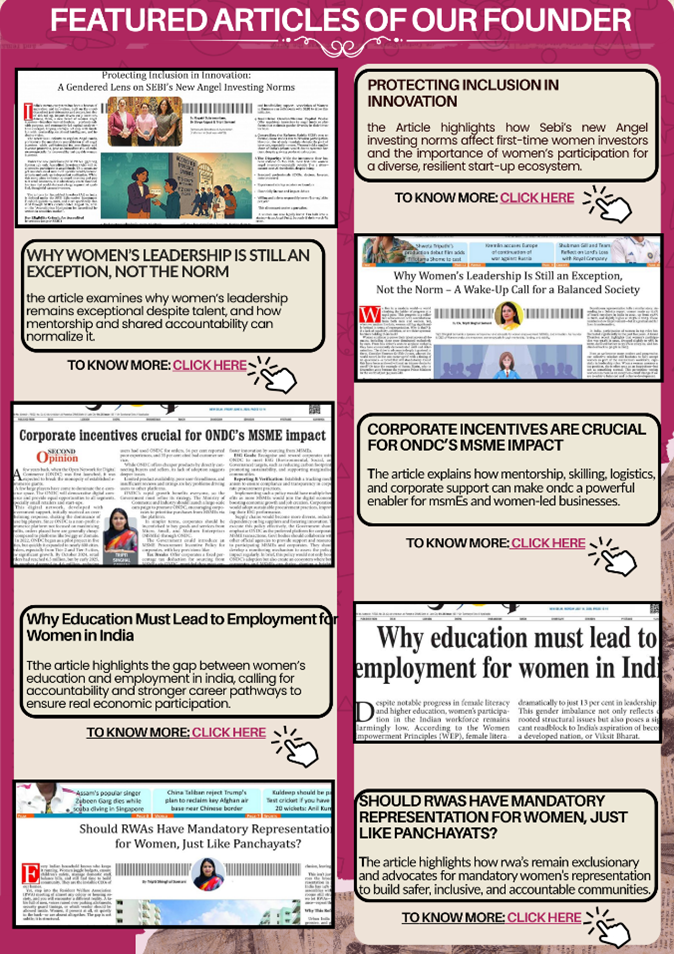
Featured Articles of our Founder – CA Tripti Shinghal Somani
Thought leadership pieces shaping conversations around leadership, inclusion, education, governance, and innovation.
CA Tripti Shinghal Somani, Founder of Womennovator, has consistently used her voice and platforms to highlight critical societal and economic themes that influence the future of women in India. Her articles are not just opinions — they are reflections of ground realities, policy gaps, and forward-looking solutions that encourage institutions, corporates, and communities to think differently.
Below are some of her featured articles that bring together perspectives on leadership, enterprise, education, governance, and innovation.
1. Why Women’s Leadership Is Still an Exception, Not the Norm
In this article, Tripti Somani questions a reality we often overlook — why are women leaders still treated as rare achievements instead of everyday normalcy? She emphasizes that the issue is not capability but conditioning and access.
The article explores how organizational cultures, lack of mentorship, and limited visibility create invisible ceilings. It calls for a shift from symbolic representation to structural inclusion where leadership roles are not gender-tagged but talent-driven. Her core message is clear: when leadership diversity becomes routine rather than remarkable, institutions become stronger, more innovative, and more empathetic.
2. Corporate Incentives Are Crucial for ONDC’s MSME Impact
This piece dives into the relationship between corporates and the MSME ecosystem, especially in the context of digital commerce platforms like ONDC. Tripti highlights that small businesses, particularly women-led enterprises, often struggle not due to lack of ideas but due to lack of ecosystem support.
She argues that corporate incentives — mentorship, procurement access, digital onboarding, logistics partnerships, and skilling initiatives — can act as multipliers for MSME growth. The article stresses that when large organizations actively empower smaller enterprises, economic growth becomes more inclusive and sustainable.
3. Why Education Must Lead to Employment for Women in India
In this thought-provoking article, Tripti focuses on the gap between education and employability. While female enrolment in higher education has improved significantly, transition into the workforce remains inconsistent.
She discusses how degrees alone do not guarantee independence unless supported by career counselling, industry exposure, internships, and mentorship. The article urges academic institutions to go beyond curriculum delivery and actively build career pathways. Education, she writes, should not just inform — it should transform lives through financial independence and professional identity.
4. Should RWAs Have Mandatory Representation for Women, Just Like Panchayats?
Here, Our Founder brings governance into everyday spaces. She highlights how Resident Welfare Associations (RWAs), despite influencing crucial community decisions, often lack balanced gender representation.
Drawing parallels with the success of women’s reservation in Panchayats, the article proposes that structured inclusion in RWAs could lead to safer neighborhoods, better civic planning, and stronger accountability. The central idea is simple yet powerful — governance becomes more effective when decision-making reflects the diversity of the community it serves.
5. Protecting Inclusion in Innovation
Innovation shapes the future, but Our founder emphasizes that innovation without inclusion risks becoming exclusionary. This article explores the challenges faced by women in startup ecosystems, funding access, and investment networks.
She advocates for intentional frameworks that ensure equal participation in technology, entrepreneurship, and research spaces. Inclusion, according to her, is not charity — it is strategy. When innovation ecosystems are diverse, creativity expands, markets grow stronger, and economies become more resilient.
Closing Note
Through these articles, Our founder CA Tripti Shinghal Somani consistently reinforces one belief — progress is meaningful only when it is inclusive. Whether discussing leadership rooms, corporate corridors, classrooms, community boards, or startup hubs, her voice bridges vision with practicality.
These writings are more than commentary; they are calls to action for institutions, industries, and individuals to rethink structures and create environments where equality is not an initiative but a natural state of growth.